





- máquinas de filtrado de aceite dieléctrico transformadores del termovacio de las etapas dobles
- equipo de tratamiento de aceite de transformadores de vacío montado en remolque móvil
- purificador de aceite lubricante (turbina / hidráulico)
- purificador de aceite del transformador del vacío de la sola etapa
- Sistema de purificación de aceite por deshidratación al vacío.
- purificador de aceite aislante
- máquina de filtro de aceite portátil
- purificador de aceite de tipo coalescente
- Separador centrífugo de aceite tipo disco
- Sistema de filtración de aceite diesel (combustible)
- máquina de filtro de prensa
- Equipo de Bomba de Vacío
- sistema de purificación de secado al aire
- equipos de prueba
- planta de tratamiento de gas sf6
- Tanques de filtración y accesorios
Acore Filtration Co. Ltd.
- Tel : +86 132 06063693
- Email : sales@acorefiltration.com
- móvil y whatsapp : +8613206063693
- Fax : +86 23 8132 4618
- Añadir : No.2, Jianhe Road, Banan District, Chongqing, China
Soporte técnico
Why SF6 Gas should be recovery, pufication, drying by SF6 Gas recovery machine
October 8,2026.
SF6 gas needs to be recovered and filtered
for three main reasons: safety, environmental protection, and economy. Recovery
and filtration are not just for saving money but also to prevent toxic
substances from harming people, to stop a potent greenhouse gas from entering
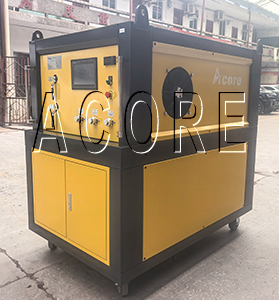
the atmosphere, and to avoid equipment failures. The SF6 Gas Recovery Machine can has functions of SF6 gas recovery,
purification, drying, storage and filling.
Safety: Decomposition products are toxic and directly threaten people and
equipment
Pure SF6 is non-toxic, but once an arc discharge, corona, or partial discharge
occurs in electrical equipment, it decomposes into substances such as HF
(hydrofluoric acid), SO₂, SOF₂, which are highly toxic and strongly corrosive.
Harm to humans: SF6 containing decomposition products can irritate the eyes,
nose, and mouth, and high concentrations pose health risks.
Damage to equipment: When decomposition products encounter water, they form
corrosive electrolytes, corroding internal metal components and reducing
insulation performance; moisture can also condense on insulation surfaces,
causing surface discharges (tracking), forming a vicious cycle of
"decomposition-corrosion-redecomposition."
It is strictly forbidden to release SF6 from equipment directly into cable
trenches or the atmosphere. It must be extracted and purified using recovery
devices before reuse.
Environmental protection: greenhouse effect is over 20,000 times that of CO₂
SF6 is one of the six greenhouse gases listed in the Kyoto Protocol, with a
global warming potential about 22,800–23,900 times that of CO₂ and a lifespan in the atmosphere of around 3,200 years.
Emitting 1 kg of SF6 has the same warming effect as emitting about 23 tons of
CO₂. In 2021, SF6 emissions in China were about 4,400 tons, equivalent
to approximately 103 million tons of CO₂.
By 2025, the Ministry of Ecology and Environment has issued the CCER
methodology, including the recovery and purification of SF6 from electrical
equipment as part of voluntary greenhouse gas reduction projects, with a
baseline recovery and purification rate set at 90%.
Economy: Gas is expensive and can be reused after purification
SF6 is costly. If it is released directly during equipment maintenance or
retirement, it is both wasteful and requires repurchasing the gas. After
recovery and purification, it can be recharged repeatedly, significantly
reducing operating costs.
Currently, recovery and purification technology is approaching a 95% limit, and
GRT SF6 gas recovery machine usually use a 90-95% recovery and purification
rate as the baseline, which is both technically feasible and economically
reasonable.
What exactly does the filtration remove?
GRT SF6 Gas Recovery, purification, drying, storage and filling system in
recovery devices generally uses a combination of a drying filter (molecular
sieve) + adsorbent + dust filter, mainly removing these types of impurities:
Moisture: to prevent decomposition product hydrolysis and equipment
condensation tracking.
Decomposition products: such as HF, SO₂, and other acidic toxic
substances.
Oil: contamination from compressors, etc.
Solid particles: dust from internal equipment wear or arcing.
The purified SF6 must be tested for purity and can only be recharged into equipment if it meets the standards, generally requiring moisture ≤ 60 PPM/V and oil ≤ 3–5 PPM/W.


 +8613206063693
 Rufus Huang
 sales@acorefiltration.com
 +8613206063693
 +86 23 8132 4618